

Standards now sit at the center of innovation, health, and trust ahead of TISE 2026
Advances in materials, chemistry, and construction have permanently reshaped what flooring products are expected to deliver. As the global flooring community prepares for The International Surface Event (TISE) 2026, this provides an opportunity to examine how flooring standards have evolved and what that evolution reveals about where the industry stands today.
Running parallel to these advances, expectations around health, indoor environments, and transparency have moved decisively into the mainstream. Together, these shifts have transformed the standards landscape from something largely technical and behind the scenes into a driver of credibility, product design, and market confidence.
This evolution has also reframed sustainability. Today’s standards increasingly reflect a people-and-planet-friendly perspective, one that balances environmental responsibility with evidence-based consideration of how materials behave in the built environment and their subsequent impact on human health.
In this article, we explore how standards within the flooring sector:
- have moved beyond basic compliance tools to become enablers of innovation
- act as mechanisms for progress rather than constraints on product development
- serve as a bridge between medical science, industry innovation, and consumer trust
- have evolved at Allergy Standards Ltd (ASL) to reflect the realities of modern materials, indoor environments, and health expectations
From compliance to capability: how standards have matured
Historically, flooring standards focused on mechanical and functional performance such as durability, wear resistance, acoustics, and fire performance. These measures remain essential. But they no longer capture the full performance profile of modern flooring products.
Today’s flooring systems are evaluated not only by how they perform underfoot, but by how they behave within the indoor environment over time. This includes chemical emissions, interaction with cleaning and maintenance practices, and the potential to influence allergen exposure. The evolution of standards reflects a recognition that flooring is one of the largest continuous surfaces in any interior and therefore plays a disproportionate role in indoor environmental quality.
Rather than limiting innovation, well-designed standards now provide manufacturers with clear performance targets, allowing new materials and constructions to be developed with confidence that health-related expectations are being met in a verifiable way.
Bridging medical science and the built environment
As standards have expanded in scope, so too has the need for cross-disciplinary expertise. The most meaningful standards today sit at the intersection of product science, environmental health, and medical understanding.
ASL occupies a distinctive position within this ecosystem. Founded and led by medical experts and scientists, ASL brings together:
- clinical and medical insight into asthma and allergy triggers
- environmental and exposure science
- laboratory-based testing expertise
- close collaboration with manufacturers and built environment professionals
Through this integrated model (ASL’s umbrella organisation, the iAIR Group, spans a standards body, certification program, laboratory capability, and educational leadership platform), ASL helps translate health priorities into practical, evidence-based criteria that industry can design to and innovate against. In doing so, standards become a bridge: aligning technological innovation with scientifically meaningful outcomes for people in indoor spaces.
ASL flooring standards: resilient, textile, and soft surface systems
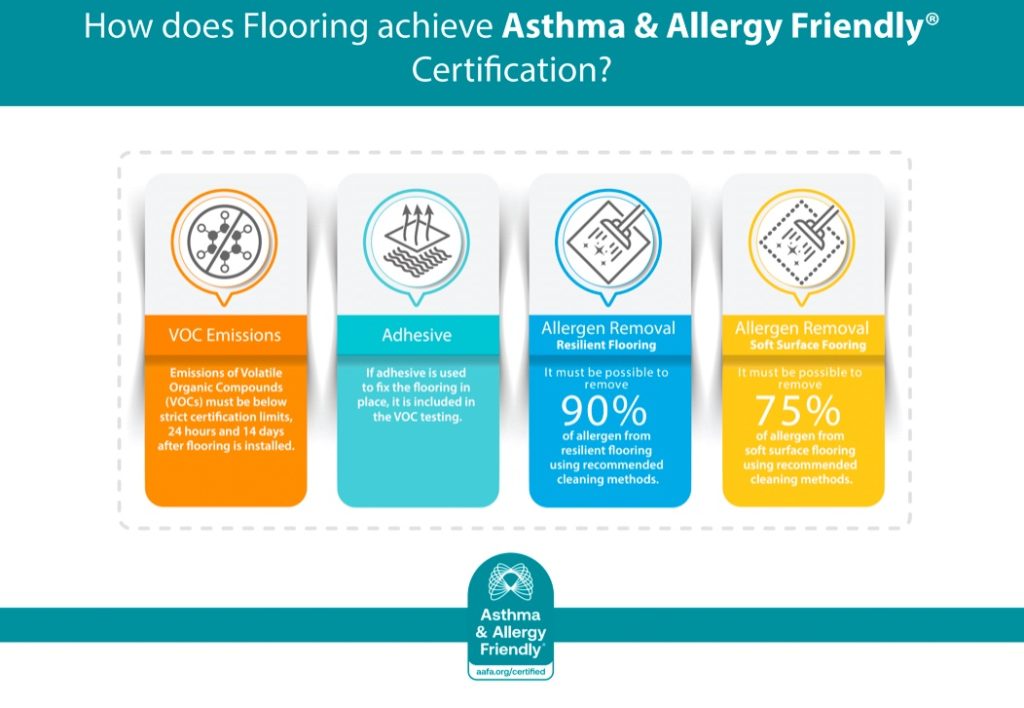
ASL’s ASP-05 Certification Standard for Flooring , which includes resilient and textile floor covering sub-categories, reflects this modern, systems-based approach. Resilient flooring and textile floor covering products seeking Asthma & Allergy Friendly® Certification are assessed using a defined evaluation framework drawing on proprietary and established scientific methods to evaluate their impact on the indoor environment.
Flooring products are subjected to biological, physical, and chemical testing to ensure they do not contribute to asthma or allergy triggers indoors. Importantly, certification considers not just the flooring material itself, but the flooring system as purchased by the consumer, including adhesives where applicable.
Allergen performance under real-world conditions: Certified flooring must demonstrate that allergens can be effectively managed under normal use and maintenance conditions, following manufacturer-recommended cleaning protocols. Standards assess both the removal of common indoor allergens, such as house dust mite and cat allergen, and the extent to which cleaning activities avoid redistributing those allergens back into the breathing zone.
Certification also verifies that allergens removed from the flooring surface are effectively captured by the cleaning system, rather than recirculated within the indoor environment, reflecting how floors are actually cleaned and occupied in functioning buildings.
Chemical emissions over time: In parallel, flooring products are evaluated for volatile organic compound (VOC) emissions using environmentally controlled chambers. Emissions are measured over an extended period to ensure levels remain low beyond initial installation, providing confidence that products support healthier indoor environments over time, not just in the short term.
Reframing soft surface flooring through science: Soft surface flooring has traditionally been viewed as challenging for individuals impacted by asthma and allergies. ASL’s standards reflect how this category has evolved.
Advances in flooring technology now allow certain soft surface products to combine comfort with effective cleanability and low emissions. Certification applies real allergen testing and emissions assessment to confirm that these products can support healthier indoor environments when properly maintained.
This science-led approach moves the conversation beyond assumptions based on legacy products, offering credible, evidence-based guidance for manufacturers, specifiers, and consumers when products meet defined certification criteria.
Carpet standards: ASL has recently introduced an addendum to its ASP-05-03 textile flooring standard to address emerging carpet technologies designed to support effective allergen management. This development reflects advances in materials science and peer-reviewed research, as well as growing consumer demand for clear, independently verified information on how products perform in indoor environments.
The addendum establishes a structured, performance-based pathway for assessing substantiated allergen-related claims, confirming that allergen burden within the carpet structure can be managed under defined conditions, that indoor air hygiene is not adversely affected during normal use and cleaning, and that existing hygiene and indoor air quality requirements continue to be met.
This provides manufacturers with a clear, science-based framework for responsible innovation, allowing new carpet technologies to be developed and validated against criteria that are meaningful to both the medical community and the built environment.
Standards as the foundation of trust and progress
As the flooring industry arrives at TISE 2026, standards are no longer simply about meeting minimum requirements but they are about enabling innovation, supporting credible claims, and aligning product performance with modern expectations around health and indoor environments.
At ASL, standards are viewed as instruments of positive change. By bringing together medical science, environmental health expertise, and product testing, ASL helps ensure that innovation in flooring is supported by criteria that are robust and relevant.
Simply put, standards are the foundation on which trust and the next generation of flooring innovation are built.
Key Words
flooring, resilient and textile flooring. carpet, standards, Asthma & Allergy Friendly® Certification Program, built environment, indoor air quality,
Related Internal Links